London’s official homelessness database, the Combined Homelessness and Information Network (CHAIN), released 2026’s first quarter report, revealing a 10% reduction in rough sleeping across the capital compared to this time last year.
Greater London
- New rough sleepers: 1,685 people were seen sleeping rough for the first time, a 16% year-on-year (YoY) reduction. 77% of those people were seen on just a single night, pointing to effective and rapid intervention.
- Living on the Streets: 680 individuals have been classified as long-term street residents, down 14% YoY but up 6% from the January-March 2026 period.
- Total number seen rough sleeping: Down 10% YoY to 3,959 from 4,392. Of that total: new rough sleepers account for 43% of all rough sleepers, 17% of those were recorded as living on the streets
Kingston upon Thames
London-wide data has shown positive momentum. Local statistics, provided by us (KCAH), gives us more of an insight into the complexity and underlying issues behind the raw stats.
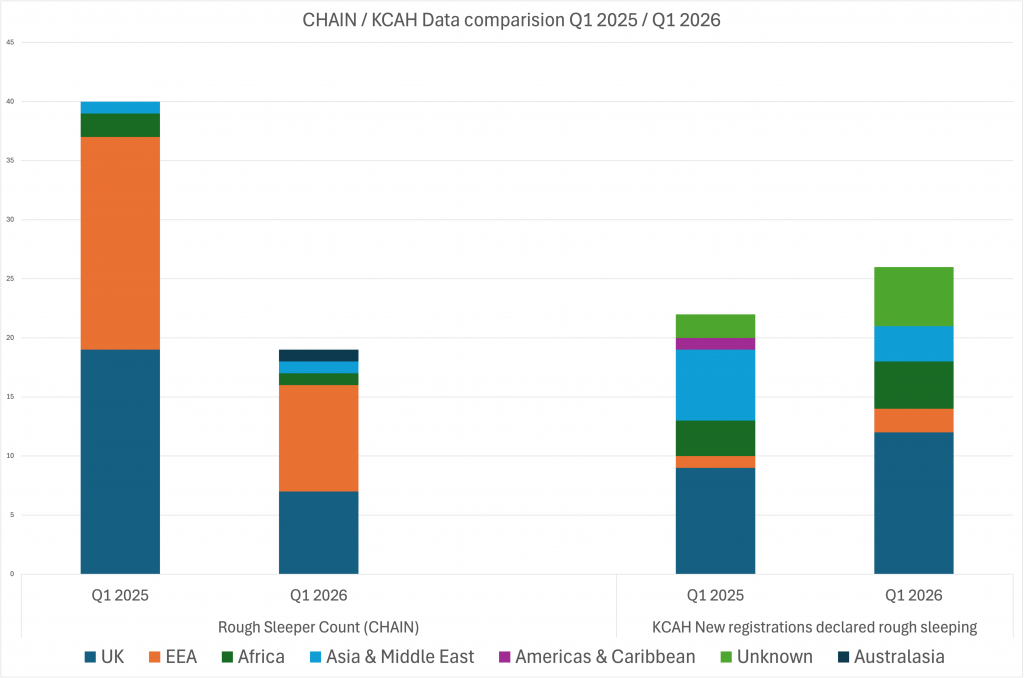
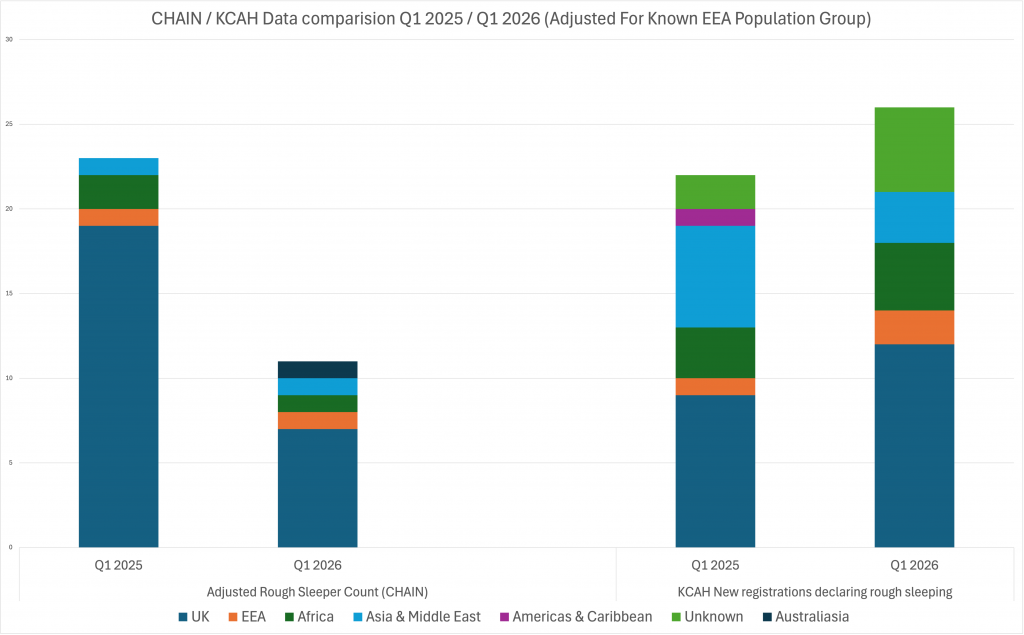
- Total seen sleeping rough: Official CHAIN data recorded 19 people sleeping rough in Kingston during Q1- a 47.5% reduction from 40 in Q1 2025. By comparison, neighboring boroughs Richmond and Merton recorded 37 and 16 individuals respectively.
- Local demand on KCAH: Through the Housing Crisis Intervention Service (HCIS), KCAH logged 117 new registrations in Q1 2026. Whilst the official number of observed rough sleepers was 19, we registered 26 new individuals declaring to be rough sleeping.
- Mental health pressures: Of the 18 assessed among the 19 observed sleeping rough in Kingston, 10 needed support for more than one of the following: mental health, drugs and alcohol. 55 of KCAH’s new registrations reported mental health issues. Of the new registrants this quarter, 35% of individuals had 2+ mental health conditions, with anxiety and depression being the leading causes.
The Broader Picture
Taking London’s statistics at face value, there seems to be a real positive direction in preventing and addressing rough sleeping across our capital. The locally collected data in Kingston unearths a root issue causing homelessness: mental health. An individual’s mental wellbeing directly impacts their ability to maintain relationships, retain employment, and sustain stable housing. With anxiety and depression being such debilitating illnesses, and many people experiencing them both at the same time, professional, unbiased support and advice from our HCIS team is at the epicentre for tackling homelessness in today’s society.